




Designer wheat, cow hide coats and happy farmers: Rural Business Conference hits the right notes for farmers

Bishop Burton Centre for Agricultural Innovations annual Rural Business Conference yet again gave a packed house plenty to think about when it was held at the College yesterday.
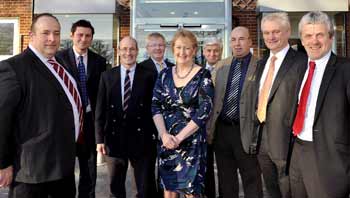
Colleges principal Jeanette Dawson explained how these issues are very much at the forefront of teaching at the College.
She said: This is a crucial agenda for farm and staff, as well as for the students, who hold the future in their very capable hands.
Our learners are currently involved in some excellent applied research looking at some very interesting topics that will no doubt help the industry face these challenges.
Its fantastic to see that agriculture is no longer treated as part of the problem and that it has moved into the centre of things at last.
First to take to the floor Graham Stuart, MP for Beverley and Holderness, explained how the Coalition Government plans to assist farmers and food producers in these uncertain times.
He explained that the Government is committed to ensuring that their policies work for farmers.
At the heart of Government we have three ministers who between them have extensive agricultural experience and who will make sure Government policy works for farmers, said Graham.
A task force has been given the job of cutting through red tape which is due to report back in April.
We want happy farmers, not farmers who are bogged down in regulation surrounding such things as animal movement and registration.
Only by being efficient and competitive will British agriculture survive and thrive. CAP needs to be repositioned to achieve food security and we need to liberalise the market and dismantle barriers to trade.
Following Mr Stuart, Professor George Marshall of the Scottish Agricultural College talked about knowledge transfer, while James Severn of Andersons Northern gave an insight into the benefits of Share Farming, which again gave delegates food for thought.
Farm manager Dominic Naylor felt the conference was extremely worthwhile.
He said: Im delighted to now attend a conference that has agriculture at the heart of discussion.
To hear this mornings debate on the importance of both animal and plant breeding in terms of maximising our potential and achieving more for less, it is very exciting.
David Neale, Business Development Manager for Masstock Arable also delivered an interesting presentation on increasing yield through plant breeding.
In order to meet demand, we must increase yields by 2% over the next 20 years, said Mr Neale.
Although this doesnt seem like a lot, we must consider that we have only managed to increase yields by 1% over the past 50 years, so it is a big challenge.
Masstock use their own money to conduct research and the company is actively farming in the UK and in countries such as the Ukraine and the Sudan.
This is a very exciting time for agriculture and there is some absolutely fascinating science coming through. We need to increase the yield from less land, so we must use science to tackle this rising demand for food.
Mr Neale showed delegates how plant breeding and precision agronomy can help cut out inefficiencies and chemical input, by developing new breeds of designer wheats that are resistant to threats such as mycotoxins, blackgrass and midges.
The afternoon session saw presentations from a number of practitioners who are already using their entrepreneurial flair to get the most out of their businesses.
Ben Stanley of Blackbrook Longhorns spoke about getting added value from the fifth quarter and amused and enlightened the crowd with ideas such as cow hide coats and Cumbrian sheepskin jackets.
All products designed to make money from what are traditionally seen as by-products of the meat trade such as hides and offal, which can have uses in the nutraceuticals industry.
Ian Tremain of Exalga encouraged farmers to consider growing algae, while dairy expert David Alvis broached the contentious issue of large-scale dairying in the UK.
David presented case studies of ventures in the US which produce milk on a mammoth scale.
Fair Oaks Farms in Indiana boasts herd of 32,000 cows, each producing on average 12,000 litres of milk per year. The animals are not treated with antibiotics or hormones and cow welfare is very much at the heart of the business.
Rather than shy away from the glare of the media, the operation actively encourages engagement with consumers. Hundreds of thousands of people travel to its visitor centre every year to find out more about the dairy industry and see calves being born.
As David Alvis explained, the UK dairy industry does not need to be limited by scale.
He said: Europe is well placed to meet the rising demand for food globally and although milk production in the UK has declined, in the future those countries currently supplying milk globally will not be able to meet the demand as climate change takes hold.
The small scale farms that have been the mainstay of modern agriculture for the last 200 years no longer have to limited by scale.
The Fair Oaks model shows that with cow comfort and welfare at the core of the business large scale dairying can work for consumers, farmers and animals.
Agriculture students Lizzie Jennings and Olivia Stockdale found the conference complemented their studies and provided a useful insight into the modern agriculture industry.
Lizzie said: Its been excellent. Its like a crash course in everything weve been studying over the last few years and it will be great way of keeping up with new technologies and thinking once weve completed our degrees.
I was particularly interested in James Severns approach to joint ventures and share farming as weve just completed an assignment on the subject.
I was also really interested in David Neales presentation on plant breeding. I am particularly interested in soil science and would definitely think about working for a company like Masstock in the future.