




Ford Vertrek Concept previews a sleeker, sportier and more stylish compact utility vehicle
Ford’s vision for a sleeker, sportier and more stylish compact sport utility vehicle (SUV) makes its European debut at the 2011 Geneva Motor Show. The Ford Vertrek concept was first shown at the North American International Auto Show in January and previews the companys ambition for a next-generation, global compact SUV that could lead the industry in both design and fuel efficiency.
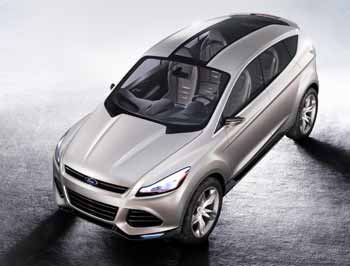
Vertrek concept is a no-compromise solution we feel utility vehicle customers will embrace around the world, said Frank Davis, Vice President Product Development, Ford of Europe. This new design is sleeker and more fuel efficient and delivers the capability, including people and cargo volume, customers demand globally.
The Ford Vertrek concept combines the best of Fords kinetic design styling and driving quality with outstanding levels of cargo space, trailer-tow and off-road capability, promising a vehicle that meets the needs of next-generation compact cross-over customers around the world.
The sleek appearance of the Ford Vertrek concept has been honed aerodynamically to help support the programme target of class-leading fuel economy and low CO2 emissions and complement the high-tech powertrain solutions Ford envisions.
Ford preliminary data show that a production vehicle based around the Vertrek concept would be at least 5 per cent more aerodynamically efficient than current comparable Ford European and North American models, such as the Escape and Kuga.
Global solution for global needs
Fords global C-segment platform allows for the efficient creation of vehicles that address consumer tastes around the world.
Customer demands are converging globally towards a compact crossover that is stylish and great fun to drive while at the same time providing the package, capability, engaging technology and fuel economy they expect, added Davis. The Ford Vertrek concept will allow us to hear directly from these customers about trade-offs they are prepared to make as we look to deliver a future production model that brings to life all these attributes.
At least 10 new models will be built on the new global C-segment platform, which replaces three platforms currently in production regionally. By 2012, the new platform will account for more than 2 million units of sales, providing Ford with unprecedented economies of scale and an opportunity to offer customers around the world an array of new technologies and product features usually reserved for premium vehicles.
Sales of cross-overs in Europe are growing rapidly up more than 200 per cent since 2000. The Ford Kuga has consistently ranked third in its segment, in which all major manufacturers compete, since its launch in 2008. Nearly 70 per cent of Kuga customers opt for the high series.
The global compact SUV segment has shown growth since 2009, led by China and the U.S. The market in China is projected to increase 60 per cent by 2011 compared with 2009.
This segment is uniquely diversified across the globe, said Gunnar Herrmann, Vehicle Line Director, Global C-cars. In the U.S. these are considered small cars, while in Europe and other markets they are considered midsize cars. No matter how you classify it, the segment is vitally important and only those manufacturers who demonstrate leadership in design, customer-focused technology, capability and fuel-efficient performance will succeed.
Kinetic design taken to the next level
The sporty and sleek Vertrek concept builds on Fords global kinetic design philosophy. This distinctive and continually evolving design language is rooted in creating cars that appear to be in motion even when stationary, while at the same time communicating the engaging driving experience that Ford cars deliver.
The starting point is creating an athletic stance for the vehicle, almost like a runner in starting blocks poised and ready to burst forward. Other key elements include dynamic lines and taut surfacing, again conveying muscularity and athleticism.
Vertrek concept builds on these kinetic design fundamentals, underscoring its on-road characteristics and off-road capability.
The Ford Vertrek concept is inspired by contemporary compact sport utility customers expectations and aspirations, said Martin Smith, Executive Design Director, Ford of Europe. It unites stylish design, world-class craftsmanship and outstanding capability to present a fresh vision that we believe will resonate globally.
High-tech gasoline and diesel powertrain solutions
The Ford Vertrek concept shows how the vision of a next-generation, fuel-efficient compact SUV could become reality by extending the reach of the companys growing EcoBoost engine and advanced turbo diesel common-rail direct-injection (TDCi) engine families while introducing Ford Auto-Start-Stop technology.
EcoBoost is fundamental to Fords strategy to provide technologically advanced, high-output, smaller-displacement powertrains that deliver uncompromised performance and fuel economy. Ford EcoBoost engines deliver fuel economy gains of up to 20 per cent and reduction ofCO2 emissions of up to 15 per cent, compared with larger, less-efficient engines.
In addition to turbocharging with direct injection, Ford powertrain engineers have enhanced EcoBoosts technology capabilities by adding variable valve timing and precisely controlling all aspects of the engine. Ford has at least 125 patents on its EcoBoost technology.
Ford Vertrek concept features the highly efficient 1.6-litre four-cylinder Ford EcoBoost engine, giving the vehicle the power of a larger engine yet delivering significantly better fuel economy and CO2 emissions.
By 2013, 80 per cent of Fords global nameplates and 90 per cent of Fords North American nameplates will have an EcoBoost option.
Advanced diesel engines
Ford also offers European customers a wide range of efficient and powerful Duratorq TDCi engines, many of which could be applied to a future production model based on the Vertrek concept. Advanced diesel technology is especially vital in Europe 96 per cent of Kugas sold, for instance, are diesel-powered.
The acclaimed 2.0-litre Ford Duratorq TDCi engine has recently been upgraded to deliver even higher efficiency with improved performance, fuel economy and refinement.
A more efficient combustion system enables greater peak power, significantly improved driveability with increased responsiveness and more pulling power at low engine speeds. It also delivers reduced fuel consumption and CO2 emissions. Depending on application, CO2 emissions are reduced by up to 7 per cent compared to the previous 2.0-litre Duratorq TDCi engine. Paired with the engine will be a fuel-saving six-speed transmission.
Automatic shutdown of engine saves fuel
Another key enabler of enhanced fuel efficiency is the Ford Auto-Start-Stop system. This system automatically shuts down the engine when the vehicle is at idle at a stoplight, for example and quickly restarts the engine when the driver wants to move off.
An Auto-Start-Stop system can reduce fuel consumption and CO2 emissions by up to 5 per cent in mixed driving conditions. In city driving and in heavy traffic with frequent stops, the savings could increase to as much as 10 per cent.
The advanced new Ford Auto-Start-Stop system has been carefully designed with customer comfort in mind, providing consistent starting and stopping performance that is smooth, quiet and seamless, requiring no changes in driver behavior. When the engine shuts down, the electronic control unit immediately prepares the engines systems for an instant restart. An integrated system of sensors is then used to detect when the driver performs an action that signals the intent to drive off, such as pressing the accelerator or clutch pedal.
As soon as the driver prepares to move away, the engine starts quietly and almost instantly; it takes the system only around 0.3 second to fire up the engine. The process is near imperceptible and happens before gear selection is completed. To support the increased number of engine starts, the starter motor is upgraded with a high-performance electric motor and a stronger pinion-engagement mechanism with reduced noise levels.
Smart Regenerative Charging
Advanced battery technology is required to ensure the main vehicle battery copes with the frequent charge-discharge cycles common with start-stop operation. Additional technologies ensure the battery is kept charged in the most efficient way.
A Smart Regenerative Charging system increases the alternator output when the vehicle brakes or decelerates. This converts the kinetic energy of the vehicle into electric energy without using additional fuel.
The free electric current is used to recharge the battery, so it can be used by the electrical systems at a later stage. This could be when the engine is switched off during a stop phase but also can be when the generator is operating in a less-efficient mode.
The battery has an advanced management system that continually monitors its status and communicates with the Ford Auto-Start-Stop system, so that the regenerative charging feature can charge the battery in the optimal way. The Auto-Start-Stop system knows how much battery charge is available, so that it can leave the engine running if the battery does not have a sufficient level of charge.
About Ford Motor Company
Ford Motor Company, a global automotive industry leader based in Dearborn, Mich., manufactures or distributes automobiles across six continents. With about 164,000 employees and about 70 plants worldwide, the companys automotive brands include Ford and Lincoln. The company provides financial services through Ford Motor Credit Company. For more information regarding Fords products, please visit www.fordmotorcompany.com.Ford of Europe is responsible for producing, selling and servicing Ford brand vehicles in 51 individual markets and employs approximately 66,000 employees. In addition to Ford Motor Credit Company, Ford of Europe operations include Ford Customer Service Division and 22 manufacturing facilities, including joint ventures. The first Ford cars were shipped to Europe in 1903 the same year Ford Motor Company was founded. European production started in 1911.