




AHDB/HGCA Winter Planting Survey results published
Results from the AHDB/HGCA Planting Survey for England and Wales, conducted in December 2012 – January 2013 by AHDB Market Intelligence, are now available. For Scotland, the Scottish Government continue to produce December planting estimates with 2012 results expected on 14 March.
Results from the AHDB/HGCA Planting Survey for England and Wales, conducted in December 2012 – January 2013 by AHDB Market Intelligence, are now available. For Scotland, the Scottish Government continue to produce December planting estimates with 2012 results expected on 14 March.
AHDB/HGCA information, which measures autumn crop planting up to 1 December 2012, is based on 2,900 responses from a representative sample of farm businesses.
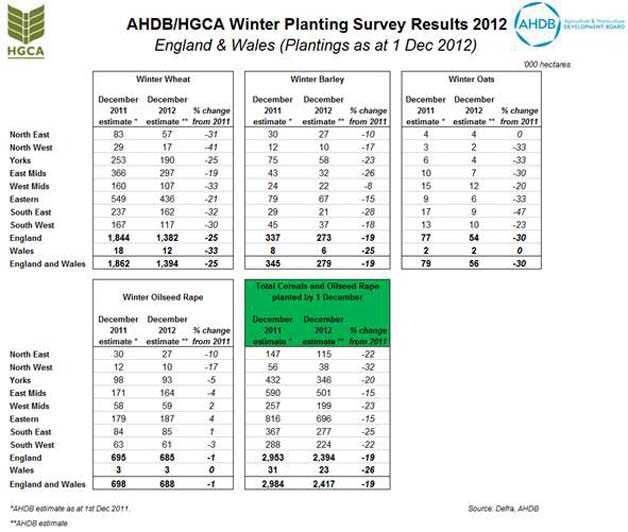
The survey shows a 19% fall to 2.417M ha in the total area planted to winter cereals (wheat, barley and oats) and oilseeds in England and Wales, compared to 2011. The results reflect an extremely difficult autumn planting season for 2012 and do not account for plantings post 1 December 2012.
– For winter wheat, the planted area* is estimated at 1.394M ha, down 25% on December 2011. However, some freezing conditions through the winter and drier weather in late February may have allowed further plantings – though in less than ideal conditions.
– For winter barley, the planted area* is estimated at 0.279M ha, down 19% on December 2011. However, a noticeable increase in the spring barley area is expected due to the wet autumn diverting land towards spring cropping.
– For winter oats, the planted area* is estimated at 56K ha, down 30% on December 2011. It is possible that some plantings have occurred beyond 1 December and that spring oats may capture some of the extra cropping land available this spring.
– For winter oilseed rape, the planted area* is estimated at 0.688M ha, down 1% on December 2011. However, it is expected that crop abandonment will be higher than usual so the year-on-year decline in harvest area is likely to be noticeable.
* At 1 December 2012, England and Wales
The December 2012 HGCA/AHDB Planting Survey is conducted by AHDB Market Intelligence. It provides key arable crop data following the loss of the Defra December Land Use Survey.
The survey was sent out to a representative sample of 5,042 farms and had a response rate of 57%.
Percentage changes are based on comparison to the December 2011 HGCA/AHDB Planting Survey, which saw the total area planted to cereals and oilseed rape by 1 December 2011 in England and Wales estimated 5% higher than December 2010
Jack Watts, AHDB Senior Analyst, said: “Given the poor weather through the summer and autumn of 2012, markets have been expecting a decline in winter cropping areas, which is reflected in new crop wheat prices.
“Since late 2012, November 2013 feed wheat futures have been trading at equal levels with the French milling wheat equivalent. In a more ‘normal’ season, the UK futures would be at around a £10-£15/t discount.”
On top of the decline in area, winter wheat crops are likely to be poorly established this season. “This may make crops less resilient against any extreme weather into spring and summer,” Mr Watts added.
For barley, the scale of spring barley plantings will be the critical element in supply, according to Mr Watts. “Traditionally, following difficult autumn planting, spring barley is the most popular ‘go to’ spring crop. However, the availability of seed could be a limiting factor.”
For oilseed rape, a noticeable decline in harvest area year-on-year is expected due to crop abandonment but whether this has an effect on prices remains to be seen. Mr Watts said: “When considering rapeseed price direction it needs to be looked at from a European perspective. In this context, the UK – and to a smaller extent, France – are the only major producing member states with crop condition issues so far.
“This spring, UK arable farmers face a significant backlog of field work. For many farmers, the first priority is likely to be establishing crops on remaining bare land before re-planting poor oilseed rape crops. It is important to keep this in mind when considering abandonment rates.”
Mr Watts urged caution when looking at plantings in the context of prices. He said: “It is important to remember that despite the condition of UK crops, UK grain and oilseed markets operate in a global market. It is critical to monitor the global situation, which will be the main price driver, while the UK situation will influence the relationship with the world/EU market.”
Full analysis of the England and Wales planting results, plus data from the Scottish Government, will be published in the next issue of Prospects, due out on 20 March.
HGCA/AHDB will carry out a full planting and variety survey this spring, with results released in the summer.