




Praise for Waitrose farm wildlife scheme
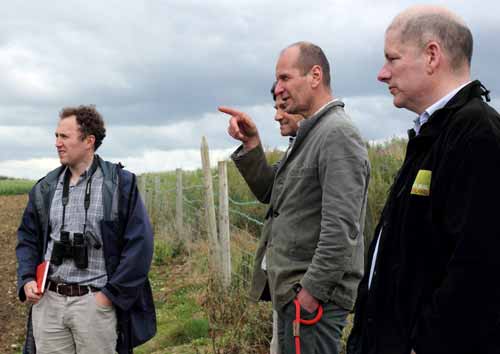
Experts from RSPB and Natural England have praised the achievements of wildlife initiative Waitrose WildCare that operates on dairy farms supplying milk under then essential Waitrose milk and cream brand. The scheme marked its fifth anniversary this year with a competition to find the farm that’s made the most wildlife habitat improvements. Joining the judging panel Gethin Davies of RSPB and James Phillips of Natural England were hugely impressed by the scale of wildlife observed. They noted the finalists’ obvious commitment for the scheme, which requires a minimum 10% of the farm holding to be dedicated to plant and wildlife habitat.
“The farms were all making a difference for wildlife, taking measures that are clearly benefiting many species be it through the management of hay meadows; pollen and nectar mixes; habitat for farmland birds; or sympathetic pond or woodland management,” said James Phillips. “This was very exciting to see.”
Gethin Davies noted the importance of 21st Century farming systems deliberately integrating the needs of wildlife. “Waitrose, through WildCare, has recognised this need and is working with farmers to find practical ways to help wildlife within modern dairy systems.” James Phillips adds “WildCare is a credit to the partnership that Waitrose and the dairy farming community have forged over the past five years. Their commitment is commendable.”
Tim Oliver of AB Sustain heads up the scheme on behalf of Waitrose and Dairy Crest. “Our strategy to target habitat provision rather than focussing on particular species has been rewarded,” reflects Tim. “Tailoring our advice to individual farms has allowed us to take into account the geography and location, unique to every holding.”
He adds “We have found that many of the 60 dairy farmers within the scheme are going well beyond the minimum criteria, finding the appropriate balance between conservation and food production. They are on average managing 25% of their holdings for the benefit of plant and wildlife habitats; This area amounts to 2,500 hectares, and includes woodland over-wintered cereal stubbles, flower-rich meadows, ponds, hedgerows and awkward areas allowed to regenerate naturally in addition to potential crop land committed to buffer zones, conservation headlands, pollen & nectar mixes, beetle banks, etc. They are also encouraged to participate in Environmental Stewardship schemes, alongside WildCare”
Winning farm
Wiltshire farming family, the Hawker’s milk 400 cows and were crowned the scheme’s competition winners. Ashton Hawker reflected on what the scheme has delivered for him; “I am far better able to identify bird species following my involvement in WildCare. I’ve lived on the farm all my life, but I didn’t have much idea about what all the birds were. The scheme has definitely cultivated an interest for me and the abundance of birds, butterflies, hares and pond life and even a family of barn owls nesting in a wagon out in the field, is great to see.”
Tim adds, “Ashton’s commitment to WildCare is outstanding and really ‘wowed’ the judges. With a remarkable 30% of his farm managed to enhance wildlife and plant habitats, his enthusiasm and commitment is matched by visible increases in hares, nesting lapwings and other species that require sympathetic farming if they are to thrive. Ashton is a deserving winner”.
Waitrose Dairy Farmers (www.waitrose.co.uk)
WildCare works with Waitrose Dairy Farmers, to encourage farming practices that benefit wildlife.
The Waitrose Dairy Farmers group, launched in 1999 (originally called the Select Farm Milk Group), now includes 60 farms – producing high quality milk, through efficient, ethical and sustainable farming practices. Waitrose has consistently paid one of the market’s highest prices for milk. By paying a premium, Waitrose enables its dairy farmers to meet costs, make a profit and reinvest in their dairies. The Waitrose Dairy Farmers Milk Scheme reflects the long-term commitment Waitrose has with Dairy Crest and this forward-thinking group of dairy farmers.
The group’s milk is sold under the essential Waitrose milk and cream brand.
WildCare (www.wildcare.co.uk)
WildCare is part of AB Sustain which is a trading division of AB Agri Ltd (Associated British Agriculture), the Agriculture Group of Associated British Foods plc. AB Sustain specialises in developing and delivering sustainable supply chain solutions from farm to processor. (www.absustain.com)The scheme is managed on behalf of Waitrose by AB Sustain’s Head of Biodiversity Tim Oliver.
Environmental Stewardship
Environmental Stewardship is administered by Natural England on behalf of Defra and funds farmers and land managers throughout England to deliver effective environmental management on their land. Environmental Stewardship builds on the earlier initiatives such as the Countryside Stewardship and Environmentally Sensitive Areas schemes.
The objectives of Environmental Stewardship are to:
Conserve biodiversity
Maintain and enhance landscape quality and character
Protect the historic environment and natural resources
Promote public access and understanding of the countryside
Environmental Stewardship has four elements; Entry Level Stewardship, Organic Entry Level Stewardship, Uplands Entry Level Stewardship and Higher Level Stewardship
For more information on all Environmental Stewardship schemes visit; http://www.naturalengland.org.uk/ourwork/farming/funding/es
About Natural England
Natural England is the government’s independent adviser on the natural environment. Established in 2006 our work is focused on enhancing England’s wildlife and landscapes and maximising the benefits they bring to the public.
We establish and care for England’s main wildlife and geological sites, ensuring that over 4,000 National Nature Reserves and Sites of Special Scientific Interest are looked after and improved.
We work to ensure that England’s landscapes are effectively protected, designating England’s National Parks, Areas of Outstanding Natural Beauty and Marine Conservation Zones, and advising widely on their conservation.
We run Environmental Stewardship and other green farming schemes that deliver over 400 million a year to farmers and landowners, enabling them to enhance the natural environment across two thirds of England’s farmland.
We fund, manage, and provide scientific expertise for hundreds of conservation projects each year, improving the prospects for thousands of England’s species and habitats.
We promote access to the wider countryside, helping establish National Trails and coastal trails and ensuring that the public can enjoy and benefit from them.
About the RSPB
The RSPB speaks out for birds and wildlife, tackling the problems that threaten our environment. Wildlife and the environment face many threats. Our work is focussed on the species and habitats that are in the greatest danger. Our work is driven by the passionate belief that birds and wildlife enrich people’s lives. We are the largest wildlife conservation organisation in Europe with over one million members, over 13,500 volunteers, 1,300 staff, more than 200 nature reserves, 10 regional offices, four country offices… and one vision – to work for a better environment rich in birds and wildlife.