




Farmers meet to discuss milk price cuts
Last week, more than 2,000 farmers attended a dairy summit at Westminster. The summit arranged by farming organisations discussed recently announced price cuts on liquid milk.

The announcements of milk price cuts and the subsequent events has generated substantial concern from the industry. In this update, DairyCo will look to examine: the details behind recent events, who is affected, factors outside of the UK and what happens next.
What’s happened?
Earlier in the month, Arla, Dairy Crest, First Milk and Robert Wiseman Dairies (RWD) announced milk prices cuts of between 1.65-2.0ppl from 1 August. These were in addition to price cuts announced for May (Dairy Crest) and June (Arla, Milk Link, First Milk and RWD) making for a total price cut of between 3.55ppl and 4ppl since May. Falling returns from the liquid milk market and falling commodity prices have been cited as the primary reasons for price cuts.
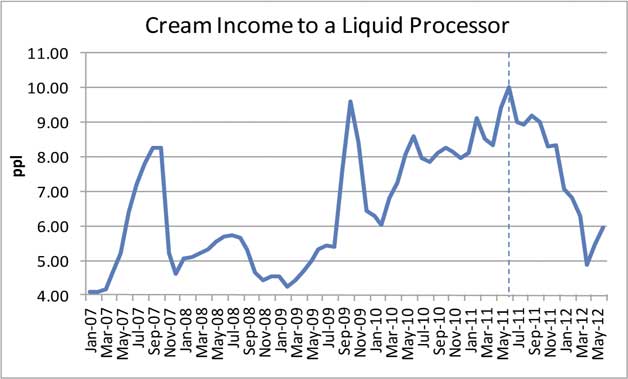
Cream income to a liquid processor
With income from surplus cream contributing towards total revenues for liquid milk processors, the drop in wholesale cream prices over the period from June 2011 to April 2012 will have impacted revenues.
Meanwhile, competition for market share at both the retail and the processing levels, along with the continued pressure from budget-conscious consumers, has served to keep selling prices for liquid milk depressed.
This means liquid milk processors have seen margins decline over the past few years as a result of competition for market share at both retail and processing levels.
Who is affected?
The immediate impact will be felt by farmers on non-aligned contracts for Arla, Dairy Crest, First Milk and RWD. Based on 2010/11 data collected for DairyCo’s guide to milk buyer reports, this will affect approximately 3,300 farmers, equivalent to 25% of GB milk production. In addition, there will also be farmers indirectly affected. Some milk buyers set their prices according to a ‘basket’ of competitors milk prices. If this basket includes one or more of those announcing cuts, these farmers are likely to see a reduction in price although it may be to a lesser extent.
What about elsewhere?
Milk prices have also declined in continental Europe. According to the LTO league table of European Dairy companies, the average price fell by 13.2% between the peak in September and May to €31.38/100kg (€0.32/litre); it is now at its lowest level since June 2010. Farmers from across Italy, Germany and France who blame over production in the EU, protested last week by creating a “milk lake” outside the European Parliament in Brussels. EU production is currently around 2% ahead of 2011/12 levels but is now past the peak and declining seasonally.
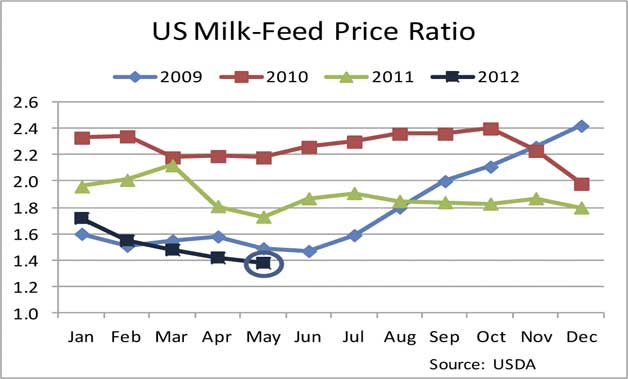
US milk-feed price ratio
Although there is a growing sense that world wholesale markets have at least temporarily reached their trough, global market conditions remain fragile. Demand for dairy products remains limited by lower than anticipated growth in emerging economies and the ongoing economic situation in developed nations. Therefore, the level of milk supply will be key to determining the future direction of global prices for dairy products.
Early supply forecasts suggested that world milk production would continue to grow in 2012. However, a combination of falling farm profitability and challenging weather has meant that milk production may fall below these forecasts. In the US, the ratio of milk price to feed costs reached its lowest level for at least 20 years in May.
In addition, the development of drought conditions across much of the US has pushed feed costs higher and milk production has decreased. As a result the USDA has reduced its July forecast of 2012 milk production to 88.8bn litres, an increase of 2.8% on 2011 but less than was forecast in June. Similar forecasts for 2013 show production fall back to 88.6bn litres. Previous forecasts showed an increase versus 2012.
In New Zealand, the 2011/12 milk season ended strongly and early forecasts for 2012/13 suggested that output would increase again. However, the La Nina weather formation, which was favourable to grass growth, has now ended. An increasing number of forecasters are also indicating an ‘El Nino’ weather formation may develop towards the end of 2012. El Nino weather events have historically resulted in drier than average conditions across the North Island, where milk production is concentrated. While the effects of each event vary, it is unlikely that New Zealand will experience the same favourable weather conditions in 2012/13 as it did in 2011/12.
Dairy Supply Chain Margins – liquid milk markets
With 2011/12 average retail prices dropping to their lowest levels in over seven years and a year-on-year increase of 11.6% in farmgate prices, DairyCo’s Supply Chain Margins report shows a year of tight margins in liquid milk markets.
Historically, trends indicate that increases in processor costs are generally matched with rising retail prices. However one of the significant features of the liquid milk market in 2011/12 was the lack of such an increase. Price promotions on liquid milk and consumers tightening their belts meant retail prices were down to 55.5ppl in 2011/12, 4.6% lower than the previous year.
The recent milk price cuts are evidence of the continued squeeze on liquid milk processor gross margins. Unless there is significant change in the structure of the liquid milk market to alter the balance of power, it is likely that processors’ gross margins will remain under pressure.
In context
The apparent strategy of processors to manage declining margins through cuts in farmgate prices instead of increasing selling prices, reinforces the need for contracts and relationships to be reviewed across the supply chain. While farmgate prices will ultimately be driven by supply and demand in wholesale markets for dairy products, the demand for milk from the various product segments will be driven by their relative profitability. Farmers’ were more able to easily re-align themselves to more profitable markets through better contracts should improve the efficiency of the supply chain.
What happens next?
Following the summit in London, farmer groups gave processors/retailers a deadline of 1 August for all actual/proposed price cuts to be reversed. There has already been some movement following this. Asda has announced that its milk premium will be increased by 2ppl from 1 August, off-setting the August cut announced by Arla. In addition, the Co-Operative has increased its premium by 0.65ppl from 1 August for some RWD suppliers.
While it will be interesting to see what happens elsewhere before 1 August, there are other challenges that have to be faced. Wholesale markets, particularly for butter and cream, have fallen in value over the last year although all commodity markets have come under some pressure. If processors exposed to these markets have no other outlet, they will be affected unless they can increase returns from retail customers. However, the way in which contracts are structured and negotiated between processors and farmers needs further examination. One area is adequate pricing signals, identifying what is valuable and communicating that to farmers. Another area is more effective notice periods for both farmers and processors. Dairy Crest has announced that farmers will now be able to quit contracts with 3 months notice, as opposed to 12 months. DairyCo will be examining these issues further in the coming weeks.