




Milk production at Wiltshire Dairy secured
A Wiltshire dairy has invested in a biogas plant to increase revenues and help it comply with NVZ regulations.
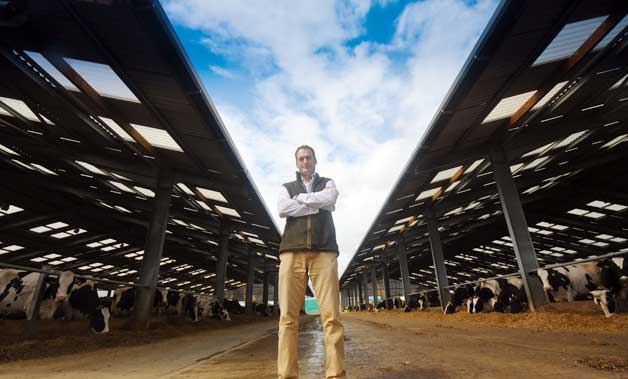
Farm manager Gavin Davies
Stowell Farms in Pewsey will also use the EnviTec Biogas anaerobic digestion (AD) facility to educate bankers about renewable energy and to improve the image of agriculture locally.
Farm manager Gavin Davies was faced with finding significant capital investment to improve the dairy unit at East Stowell and to meet amended slurry storage regulations.
The EnviTec plant, which reached full capacity this month, is capable of producing 4.1 million kWh of electricity and 3.55 million kWh of surplus heat.
Electricity produced by the plant will be used on the farm and sold to the grid under the 20-year Feed in Tariffs. About 85 per cent of the electricity will be exported, the balance being used on the farm.
Heat will be used on the farm, and there are plans to pump the surplus to a leisure centre and two schools in Pewsey.
The AD unit will generate annual revenues of more than £750,000, and it helped secure backing for state-of-the-art housing and handling infrastructure for 500 cows.
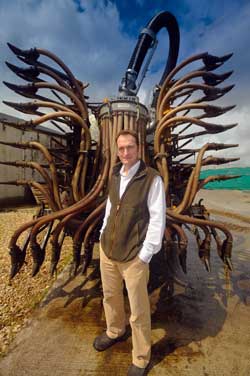
“The digestate produced at the end of the process saves us a lot of fertiliser costs”, says Gavin Davies
Mr Davies said: “The AD plant has secured milk production at Stowell. It’s also secured the existing workforce and allowed us to take on additional full- and part-time employees.
“Farming is a commoditised business, so predictability of income is at a premium, but the income and savings we get from AD are pretty much set and they are long term.
“That allows us to make much more informed and forward-looking business decisions.”
The plant is fed with maize silage, waste feed and slurry – all of which are produced on the 1,315 hectare (3,250 acre) beef, sheep, arable and dairy operation.
Mr Davies said: “The revenue and savings from producing your own heat and power are considerable, but the benefits are much more wide-ranging than this
“An AD plant helps with slurry management, which means there’s no need for a lagoon and that in turn reduces odour.
“The digestate produced at the end of the process saves us a lot of fertiliser costs and unlike slurry the nutrients are readily available.”
Mr Davies is planning to use an education centre overlooking the new milking parlour for community open days – and to host groups of potential funders with little knowledge of farm-scale renewables.
He said: “I am absolutely passionate about improving the image of agriculture. It’s the responsibility of farmers to do that by educating not just the youngsters, but the teachers and the bankers as well.
“We approached three banks, and two of them hadn’t really got the faintest idea about AD.
“In fact, backing the AD side of a dairy business should be a no-brainer because it’s almost index linked and for us it represented a better investment than wind or photovoltaics.
“People see farmers in the UK who develop AD plants as being forward thinking – but go out to Germany, it’s been working there for years.”
Between 240 hectares (600 acres) and 280 hectares (700 acres) a year are given over to maize at Stowell. The intention is to produce about 8,000 tonnes of silage to feed the AD plant and 4,000 tonnes for cow feed.
John Day, UK sales manager for EnviTec Biogas, said: “Gavin’s passion for dairy and for farming as a whole was obvious.
“We worked with him to come up with a scheme that would secure the viability of the dairy facilities and de-risk the business for many years.”