




Charity demonstrates how trees can aid farmers in times of crisis
The Woodland Trust, Bidwells and Trumpington Farm Company hosted an event this week to launch a new report demonstrating how trees can help arable farmers tackle drought and flooding.
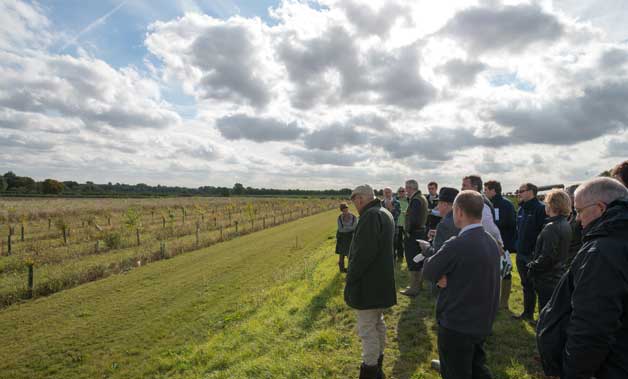
Looking at how trees can help farming – WTPL Phil Lockwood
The event hosted by Bidwells in Cambridge was held to launch the Trust’s new report – ‘Trees on Arable Farms’ – which explains how trees can be part of the solution to climate problems facing farmers today.
Following the NFU’s statement this week about the impact of extreme weather events causing a significantly poor harvest for 2012, the report should make interesting reading for members of the farming sector who are looking for a cost effective way to tackle drought and flooding.
The NFU confirmed that this year’s harvest is the worst in years – with some yields being reduced by 30% – due to an extremely dry spring followed by a wet summer. The cost of grain has risen and will impact on the food industry as well the rest of the sector due to rising feed costs for livestock.
The Woodland Trust is offering advice and support to farmers who want to try woodland creation as a new method of combating drought and flooding.
The Trust believes creating and maintaining a landscape rich in trees and woods is vital to meet the challenges of climate change, while maximising productive use of the land and supporting biodiversity. The Woodland Trust believes planting trees and farming should not be viewed as competing land uses, but complementary ones.
John Tucker, director of woodland creation at the Trust, said: “In the UK, trees and woods have often been seen as almost antagonistic to food production. Yet, they are absolutely integral to adapting land to climate change; through provision of shade and shelter, managing surface water and erosion, reducing energy costs and generating renewable energy as well as supporting biodiversity. Trees and woods thoughtfully integrated into farms have an important role to play.”
Richard Pemberton, Director of Trumpington Farm Company kindly hosted the event as he is planting woodland on his land with the Trust. His family have farmed the land since 1675, and will now be incorporating trees for wood fuel production, biodiversity, and to reduce water-logging in field corners. Richard said: “Trumpington Estates has been working with the Woodland Trust since 2008, and the help provided by the Trust through its MOREwoods scheme and Jubilee woods project has been invaluable in facilitating the integration of new woodland planting into what was a bleak East Anglian arable landscape.”
Drought
The Woodland Trust says trees planted as shelter belts help to reduce wind speeds, meaning water loss through evapotranspiration1 is slowed. This allows the sheltered crop to retain more water and use it efficiently. In the UK such shelter belts are relatively uncommon, but studies have shown cereal yields of sheltered crops can be higher than that for unsheltered crops, particularly in years when the weather is hot and dry.
Flooding
Soil baked by drought, followed by heavy rain, can increase water run-off, making ground water slower to replenish. Heavy rains this year have highlighted the numerous problems water run-off brings to the farming industry and the environment. Through strategic tree planting, the damaging effects of flooding to farmland can be significantly reduced and water infiltration can be improved by up to 60 times after just three years.
More than 2 million tonnes of top soil is eroded annually in the UK, resulting in a loss of resources such as seeds, fertilisers and pesticides, and incurring replacement costs and labour. Planting trees can help reduce soil erosion and nutrient loss, helping farmers fight the costs of surface water flooding.
As well as damaging crops and degrading soil, run-off causes fertilisers and chemicals to be carried into water courses, damaging water quality and river biodiversity. An estimated 25% of phosphates and 50% of nitrates in rivers are from agricultural sources. 70% of soil sediment in rivers is also believed to come from farming – this can be reduced by planting trees to help stabilise riverbanks.
Trees also attract insects which in turn pollinate crops and other plants. According to the Bee Farmers Association, at least 39 crops grown for fruit or seed are insect pollinated. DEFRA estimate that pollination supports £1 billion worth of UK food production each year.
The Woodland Trust’s in-house team of advisers have years of experience working with people to design planting schemes with real benefits. The service is free, and includes a site visit to check land suitability and create a planting design. There’s help and support applying for funding and the Trust can even contribute funding through it’s own MOREwoods scheme for planting projects which are ineligible for FC grants.
John Tucker continued: “We hope anyone wanting to plant trees will get in touch with us to take advantage of the help we offer. We are here to assist with advice and support in making the most of the available funding.”
For more information or help and advice on tree-planting, contact the Woodland Trust on 0845 293 5689