


Changing attitudes to water
Britain needs to take the issue of water security more seriously in spite of the country appearing to have increasingly wet summers as demonstrated by last year’s weather, says a food expert from Harper Adams University.
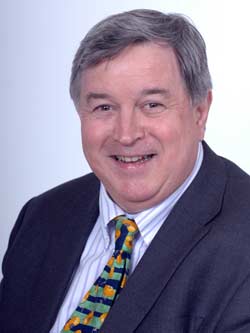
Ralph Early, Harper Adams University
Water is something people in Britain think little about until the water companies announce restrictions on the use of hosepipes for gardens and washing cars.
But that needs to change according to Ralph Early, Head of the Food Science and Agri-Food Supply Chain Management Department at the university in Shropshire.
Speaking after marking World Water Day 2013 on March 22, Mr Early said after last summer, with continual news headlines telling of torrential rain and flooding, it was hard to see that maintaining an adequate water supply was really a problem for the country.
He said of course, just as last year’s excessive rainfall came as something of a surprise, following a very prolonged dry period, we could just as readily be launched into severe drought by the anthropogenic global climate change that we are now witnessing.
But he added: “Water is not just a precious resource. It is an essential resource.
“As our ancestors evolved from aquatic to terrestrial life-forms they took the sea with them, and as human beings our bodies contain around 60 per cent water.
“Water is the medium in which much of the cellular biochemistry that creates and maintains life occurs. Without it life will certainly cease. Yet, do we hear our politicians and business leaders talking about national water security?
“Following the world food price spikes in 2008, concern has been raised in the corridors of power about food security, but someone, somewhere seems to be missing the point. What about water security? Without water there can be no food!”
Mr Early said the issue was overlooked my many as the country appeared to have a lot of water – most of the time.
“But one thing we are really good at is wasting water. Of course we are also really good at wasting much of the food we buy, which has been produced using water,” he added.
“Indeed, how many people even think about how much water goes into producing the food they eat? In 21st century, obese Britain, it is shameful the way we take food for granted. It is doubly so the way we don’t even think about how much water we waste, both directly – leaking water mains, letting taps run, filling the bath too full, etc – and indirectly – buying food we don’t eat, then throwing it away.”
To put this into perspective, to produce 1kg of boneless beef it takes about 6.5kg of grain, 36kg of roughage and 155 litres of drinking water for the animal, but the water required to produce the animal feed is around 15,300 litres. This means that the water required to produce 1kg of beef is some 15,500 litres.
Another example is carbonated cola, which takes around three litres of water to process one litre, not counting the water involved in growing the sugar used to sweeten it.
Mr Early said: “Whatever we eat or drink there is a hidden water cost. This is ‘virtual water’, the water that we don’t see, don’t consume with food and certainly don’t think about.
“As a country with a population heading towards 70 million, we are over populated, especially when one considers that we are only around 60 per cent self-sufficient in food.
“We rely on other countries to help feed us. We also rely on their water, which may be in short supply.
“When we import food it saves us water. It can also provide much needed trade for poor countries. But, if we are too greedy, in return for valuable imports we risk exporting drought.
“A fine balance has to be maintained. If we are to be good citizens in a world where food will become short as the global population heads towards nine billion in 2050, we must produce more of our own food. Importantly, if we are to do so, we must preserve as much of our own water as possible, and use it wisely.”
To learn more about World Water Day visit http://www.worldwaterday.org