




Ensuring water availability for crop production
The last few years have highlighted the importance of water in arable and horticultural production.

Congham Farms Limited in Norfolk has recently constructed a 12 million gallon reservoir
As the demand for natural resources continues to grow, growers need to plan for the potential impacts of factors such as climate change and reform of the water abstraction licensing regime.
The pressure on water availability is being felt particularly in East Anglia and the South East due to a combination of climate and population. In these areas climate change models predict a slight decrease in average annual precipitation over the next 20-50 years, but with more winter rainfall and drier summers. Overall weather patterns are expected to become more unpredictable, increasing the importance of being able to control access to water.
A report produced by the Potato Council and Cranfield University last year considered the availability of water in traditional potato growing areas, such as East Anglia and the and the Midlands. One of the report’s authors, Dr Andre Daccache comments, “It is most likely that we will have lower precipitation in summer and more in winter. But there will be higher variability with a lower level of probability.”
One of the findings of the research was that by 2050, most potato growers will need to increase irrigation by 14-30%, however changing weather patterns may see a slight yield increase of around 5%.
Being able to store water when it is available in the winter and use it when most needed in the summer is becoming an increasingly important aspect of farm management. With this in mind, Congham Farms Limited in Norfolk has recently constructed a 12 million gallon reservoir. Based 6 miles to the east of Kings Lynn, Congham Farms Limited farms around 1,200 acres with cropping including wheat, barley, sugar beet, potatoes and oilseed rape. In addition, land is let for growing parsnips.
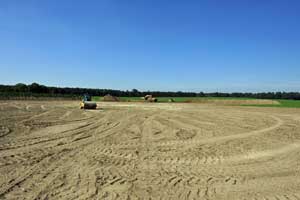
Barclays has supported Congham Farms Limited with a £250,000 loan to finance the project
Barclays has supported Congham Farms Limited with a £250,000 loan to finance the project after the business recognised that its existing borehole water source was inefficient.
Michael Mason, Director, Congham Farms, explains: “The farm has held an abstraction license for 24 million gallons of water from a borehole since 2001, but we have been unable to fully utilise this facility due to a lack of pumping capacity, meaning that we couldn’t pump sufficient water to irrigate both parts of the farm simultaneously and enlarge the acreage of potatoes, so it was decided to build a new 12 million gallon reservoir.
“We approached a number of contractors, C J Pryor from Hatfield Common in Essex worked alongside engineer, A J Freezer from Swaffham to deliver a water storage solution to meet the needs of the business. After initial trial digs were carried out it was discovered that the site had a stable chalk base which was suitable for a lined reservoir across approximately four acres in area. Once the reservoir was finished, a new pumping station was built and the reservoir was filled in October 2011.”
Martin Redfearn, Head of Agriculture at Barclays comments: “This season has shown the importance of irrigation and water availability. As demand for water increases and local weather patterns change, more and more growers will need to ensure they have sufficient access to water.
“In some cases this will involve the construction of traditional reservoirs filled from winter surface water, but in others more novel approaches such as filling reservoirs from the underlying groundwater or peak flow harvesting may have to be developed.
“Because Barclays Agricultural Managers understand the need for water, and that there is no one-size fits all solution, we are able to help finance different types of project. For example, a lined reservoir can cost twice as much to build as a similar sized clay facility, but the latter obviously needs suitable geology.”
Water is increasingly becoming an issue for the entire food supply chain and a number of processors, packers and retailers are now involved in assessing and improving the water footprint of their products. Even where farmers have access to sufficient water there may be opportunities to improve water use efficiency through the use of different application techniques or more modern equipment.
Investing in water storage, improved irrigation scheduling or more accurate equipment may require an immediate capital investment, but could lead to future savings in terms of fuel, water and abstraction requirements as well as adding value to the land or farm, as the demand for water increases and the competition for licenses increases.