




Spotlight on climate change as minister goes on-farm

Steps Scottish farmers can take to improve efficiency and reduce agricultures impact on climate change were under the spotlight when Stewart Stevenson, Minister for Environment and Climate Change visited Torr Farm near Dumfries.
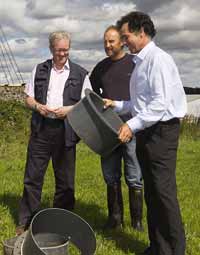
The Minister toured Torr with the Patons, their SAC FFBC project facilitator Gillian Reid and SAC Climate Change Manager Rebecca Audsley. He saw and heard how the Patons have introduced a number of measures which, while helping to reduce the farms emissions, have also saved the business money.
For example, steps have been taken to make better use of organic manure and improve livestock management efficiency. Energy use has been reviewed and is now monitored. As an organic farm, Torrs increased use of clover to fix nitrogen in the soil has also been an advantage but this, like the other practices Torr has introduced, can also reap significant benefits on conventional farms.
During the Ministers visit, nitrous oxide monitoring chambers were being installed at Torr by Dr Bob Rees, Head of SACs Carbon Management Centre. These will enable the farm to measure how much nitrous oxide is being released from soils on different parts of the farm.
Stewart Stevenson said: Torr Farm clearly demonstrates that farmers are part of the solution to tackling climate change. Emissions from agriculture and related land use are estimated at 20% of Scotlands total. The agriculture sector recognises it has an important role to play to tackle emissions, and that is why we are working in collaboration with the industry through the voluntary Farming for a Better Climate initiative.
The Scottish Government has also recently announced plans for an Agri-Renewables Strategy to help farmers and land managers grasp the benefit of the renewables revolution sweeping Scotland.
Farming for a Better Climate has had a great response from those involved, and results will inform future policy decisions. Practical steps can be taken, such as making efficiency savings when using energy and fuels, which not only helps the environment, but makes financial sense too.
I was particularly impressed to see the simple but very effective approach to better energy use on Torr Farm. After a farm energy audit identified large energy consumption in the milking parlour, some straight forward measures, such as extra insulation, were taken. A smart meter which monitors energy use every half-hour is now in place, so Torr Farm can see exactly where further efficiencies can be made.
SACs Gillian Reid said: The Scottish Government has set an ambitious target to reduce Scotlands greenhouse gas emissions by 80% by 2050. Agriculture and related activity accounts for around 20% of Scotlands overall emissions so farmers have an important role to play. As a Climate Change Focus Farm, Torr is at the centre of this effort and we were delighted to show the Minister what has been achieved over the past year. Ross and Lee have been very enthusiastic about the project and have been keen to implement new ideas.
Ross Paton said: We were very pleased to welcome the Minister onto Torr and to have discussed the various measures we have put into practice. We have learned many things from our first year and are looking forwards to exploring further measures that will improve our efficiency and reduce emissions.
For more information about FFBC please visit http://www.sac.ac.uk/climatechange/farmingforabetterclimate/.
Torr Farms 170 dairy cows are mainly Holstein-Fresian and Montbelliarde, with a few Ayrshire and Norwegian Red. The business retains all of the offspring from the dairy herd, either for breeding or for finishing, with around 100 head of cattle being finished per year. Of the total land area approximately 100 ha are woodland or rough grazing, approximately 80 ha are used for growing cereals, namely arable silage, spring barley and winter wheat, and the rest is sown to grass for grazing and silage.